
Climate change is a global crisis that affects every continent, but its impacts are particularly severe in Africa.
Impact of Climate Change on Africa
The continent, known for its rich biodiversity and vibrant ecosystems, is facing unprecedented challenges due to rising temperatures, changing precipitation patterns, and increasing frequency of extreme weather events.
These climatic shifts threaten not only the natural environment but also the livelihoods and well-being of millions of Africans.
In recent years, Africa has experienced some of the most dramatic evidence of climate change.
From prolonged droughts in the Horn of Africa to devastating floods in Southern Africa, the consequences of a warming planet are becoming ever more apparent.
These environmental changes have profound implications for agriculture, water resources, and food security, making the continent’s path to sustainable development increasingly complex.
Below are the Updated Data Points on Climate Change in Africa
- Temperature Increases:
- Africa is warming faster than the global average, with temperatures in recent decades rising at a rate comparable to or higher than other continents.
- Extensive areas of Africa will exceed 2°C of warming above pre-industrial levels by the end of this century (World Economic Forum).
- Sea Level Rise:
- Sea levels are rising at an accelerated rate along Africa’s coasts, reaching 5 mm per year in several oceanic areas surrounding the continent.
- This rate exceeds the global average of 3–4 mm per year and poses significant risks of coastal erosion and habitat loss (World Meteorological Organization).
- Extreme Weather Events:
- Africa has experienced increased frequency and severity of extreme weather events, including droughts, floods, and tropical cyclones.
- For instance, Tropical Cyclone Idai in 2019 was among the most destructive recorded in the southern hemisphere, causing widespread devastation (UNFCCC).
- Impact on Agriculture and Food Security:
- Climate change has led to a 45.6% increase in the number of undernourished people in drought-prone sub-Saharan African countries since 2012.
- The reduction in crop productivity due to heat and drought stress, as well as increased pest and disease damage, poses severe threats to food security (UN News).
- Economic Costs:
- Adaptation and Mitigation Costs:
- The cost of climate adaptation in sub-Saharan Africa is estimated to be between $30 to $50 billion per year over the next decade. These investments are crucial for building resilience and supporting economic development in the face of climate impacts (UNFCCC) (World Economic Forum).
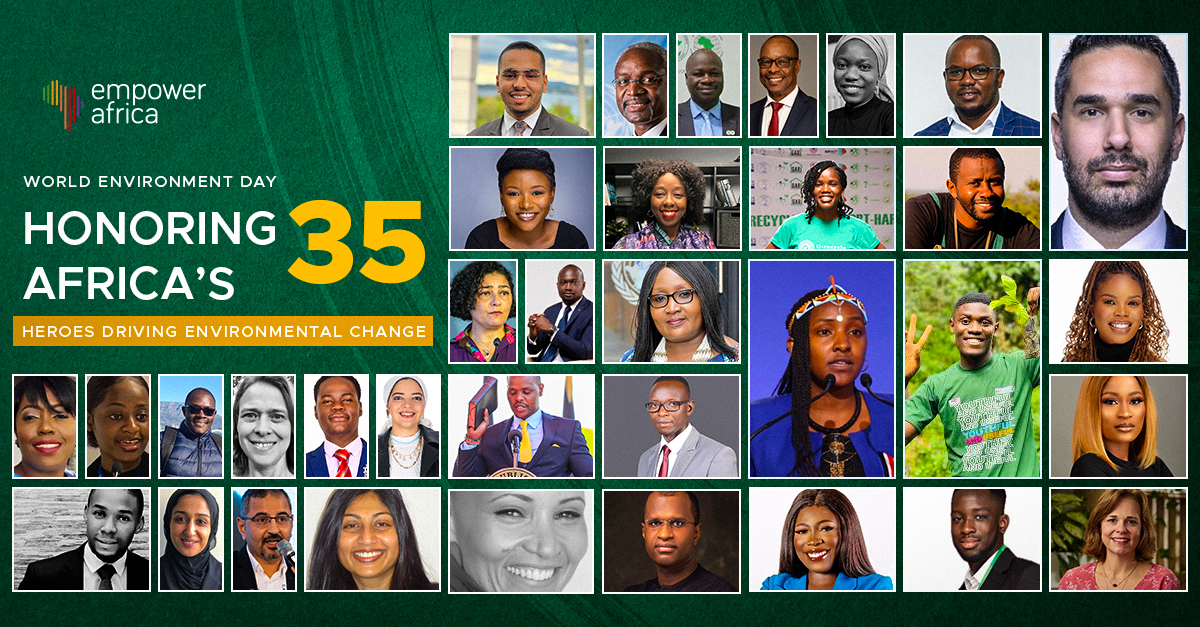
Spotlighting Africa’s Environmental Champions
As we observe World Environment Day, it’s crucial to recognize and celebrate the individuals making significant strides in combating climate change and promoting environmental sustainability across Africa.
These champions are not only addressing the pressing challenges posed by climate change but also driving innovative solutions that benefit communities and ecosystems.
- Elizabeth Wathuti – Founder and President of Green Generation Initiative
- Nyombi Morris – CEO, Earth Volunteers
- Oluwaseyi Moejoh – Executive Director & Co-founder, U-recycle Initiative Africa
- Anthony Nyong – Director, Climate Change and Green Growth
- Fatou Jeng – Youth Representative – United Nations Secretary General’s Early Warning System for All
- Jocelyne Tsonang – Project Manager Africa, Green Bond Corporation
- Ibrahim Thiaw – Executive Secretary, UN Convention to Combat Desertification
- Dr. Al-Hamndou Dorsouma – Division Manager, Climate and Green Growth Department at African Development Bank Group
- Mirey Atallah – Head of Nature for Climate Branch at United Nations Environment Programme
- Moubarak Moukaila – Head of Environment and Climate Finance at West African Development Bank
- Dr. Eng. Festus K. Ng’eno – Principal Secretary (PS), State Department for Environment & Climate Change
- John Ewoi – Environment and Social Manager at Verdant Capital
- ROSE MWEBAZA – Director and Regional Representative for Africa at UNEP
- Michael Waiyaki Nganga – Founder, Miti Alliance
- Toni J E Beukes – Head of Environment, Social and Governance (ESG) at HYPHEN Hydrogen Energy
- Hatim Aznague – Climate Policy Analyst
- Onyinye Anene-Nzelu – Head, Mini GridsHead at ENGIE Energy Access
- Mohammed Dahiru Aminu – Non-Resident Fellow at Africa Policy Research Institute
- Martin Lyambai – Environmental Finance Officer at Biodiversity Finance Initiative
- Jumoke (Mujidat) Omodeni – Director at EcoSciGen
- Samuel Osei-Amponsah – Community Coordinator at ETHAccra
- Oghosa Erhahon – Co-Host, Global Tales of Carbon Transition
- Abimbola Abikoye – Climate Change Consultant at DARNA Research ApS
- Dr Meggan Spires – Director, Climate Change, Energy & Resilience at ICLEI Africa
- Shamini Harrington – Vice President: Climate Change at Sasol
- Zarina Moolla – Head of Climate Action Implementation (Africa) at C40 Cities
- Naoufal Mahdar – Vice-President, Climate Action & Decarbonisation at OCP S.A
- Miguel Ugochukwu Peters – CEO, African Circular Business Alliance (ACBA)
- Nachilala Nkombo – Founder Women Leaders for Climate Action
- Linda Evelyn Namulindwa – Climate Justice Activist at Green Futures Initiative
- Wako Joel – Environment Journalist
- Sophie De Coninck – Climate Facility Global Manager at UNCDF
- Jonah Kirabo – Country Lead at Climate Clock
- Sara Khairy – Climate Change and Sustainability Services (CCaSS) at EY
- Hamza Al-Assad – Head of Climate Strategy and Regional Delivery (MENA) at EBRD