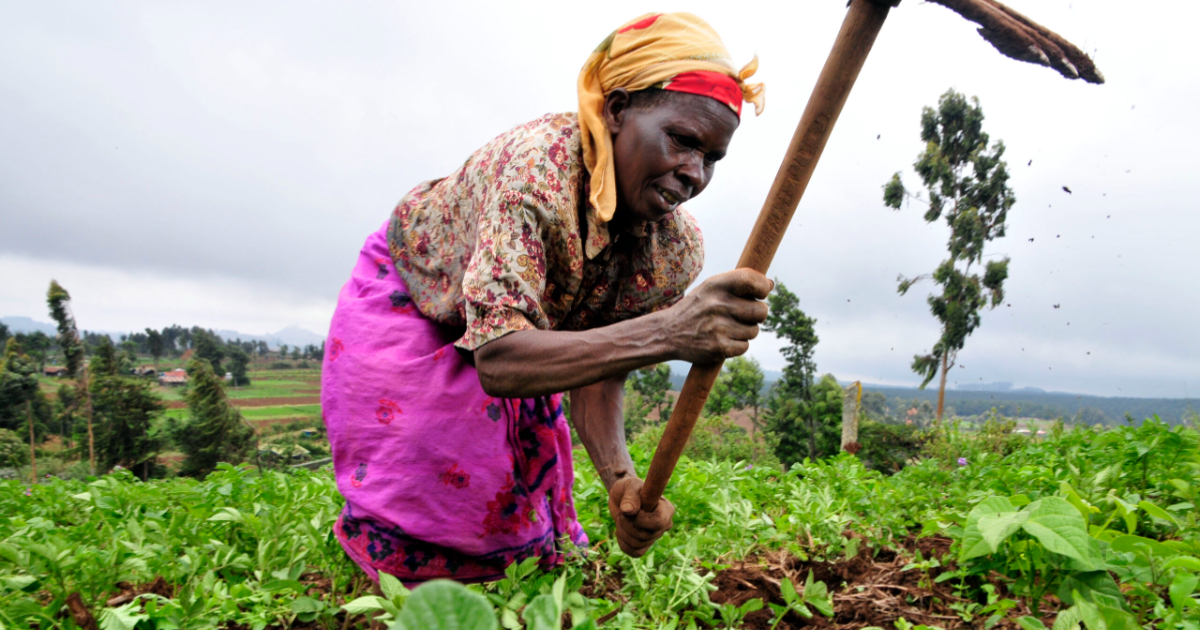
This imbalance is not anecdotal; it is structural.
For context, Agriculture accounts for approximately 46% of total employment across Africa, making it the single largest source of livelihoods on the continent.
In many economies, it contributes between 20% and 30% of GDP, anchoring both rural incomes and national food systems.
Yet despite this economic centrality, agriculture consistently attracts less than 3–5% of total commercial bank lending.
This disconnect between economic importance and financial allocation has created a widening financing gap, now estimated at over $100 billion annually.
The consequences are visible across the system: undercapitalized farmers, constrained agri-enterprises, rising food imports, and increasing vulnerability to climate shocks.
And this imbalance is not marginal, as it sits at the center of Africa’s ability to achieve food security, reduce import dependency, build climate resilience, and drive inclusive economic growth.
Understanding the $100 Billion Gap: What the Number Actually Represents
Before analyzing its implications, the financing gap itself requires closer examination.
The widely cited $100 billion figure is not a single measured shortfall, but rather a consolidated estimate derived from multiple institutional datasets, particularly from the International Finance Corporation (IFC), the African Development Bank (AfDB), and sector-level analyses of agri-SME financing.
At its core, the estimate reflects the difference between demand for external finance across agricultural value chains and the actual supply of capital from formal financial institutions.
The IFC’s underlying modelling is particularly instructive, as it estimates a $117 billion unmet financing need across agri-SMEs and smallholders in Sub-Saharan Africa, capturing both working capital and long-term investment requirements.
This includes financing for inputs, equipment, aggregation, processing, and trade.
Within this, agri-SMEs alone, which are estimated at roughly 130,000 enterprises across the continent, require close to $90 billion annually, yet receive only about $15–20 billion in formal financing flows.
What emerges is not a single gap, but a layered deficit:
A smallholder financing gap, where farmers lack access to seasonal and productivity-enhancing capital
An SME financing gap, where enterprises cannot scale due to limited working capital and asset finance
A value chain financing gap, where infrastructure such as storage, irrigation, and logistics remains underfunded
Taken together, these layers form the aggregated $100B+ annual shortfall.
Just as important is what this figure does not fully capture – It excludes large portions of public infrastructure investment, as well as the rapidly growing need for climate adaptation financing across food systems.
In reality, the capital required to fully transform Africa’s agricultural sector likely exceeds this headline number by a significant margin.