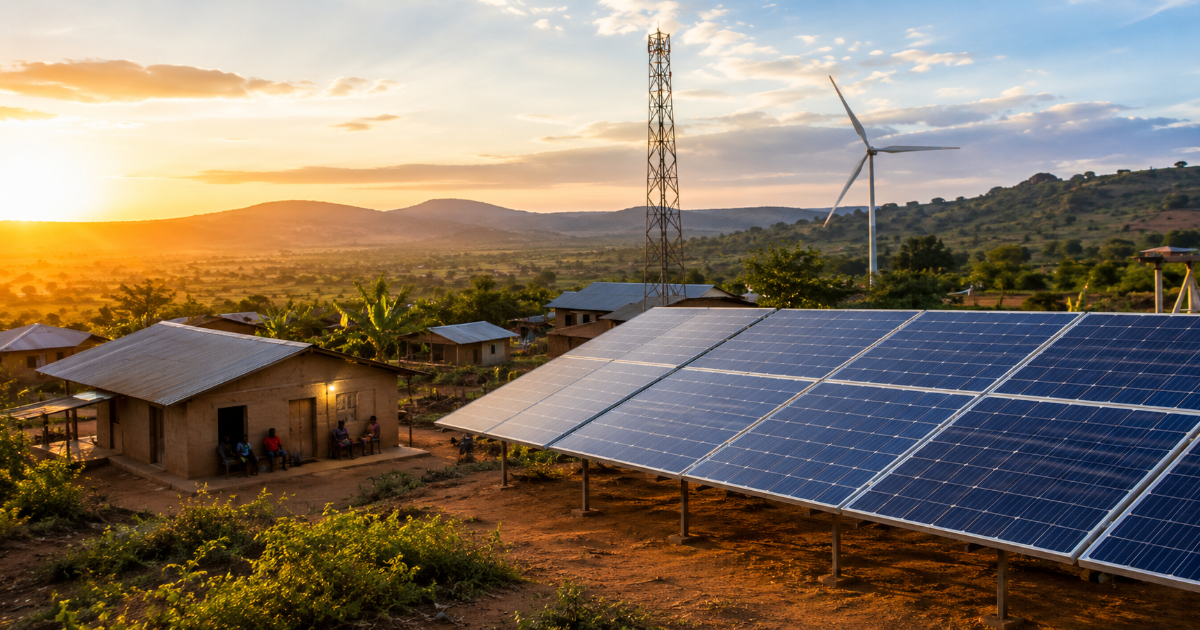
The new permanent-capital vehicle will provide patient equity financing to companies operating in sectors such as mini-grids, solar home systems, productive-use energy technologies, and clean cooking solutions.
Inspired Evolution, the African climate-focused investment firm, has been appointed by shareholders as the investment manager for the platform.
Founding shareholders include the International Finance Corporation (IFC), the African Development Bank Group and its Sustainable Energy Fund for Africa (SEFA), The Rockefeller Foundation, Trade and Development Bank (TDB Group), Nordic Development Fund (NDF), the John D. and Catherine T. MacArthur Foundation, and FirstRand Limited.
The launch marks a significant step in efforts to close one of the largest financing gaps facing Africa’s energy transition: access to long-term equity capital for distributed renewable energy companies serving rural and underserved communities.
At least half of Zafiri’s capital is expected to be directed toward mini-grids, solar home systems, and clean cooking businesses.
These technologies are increasingly viewed as the fastest and most cost-effective way to provide electricity to communities that remain beyond the reach of national power grids.
According to Mission 300 partners, distributed renewable energy solutions are expected to account for at least 50% of new electricity connections in Africa by 2030.
Zafiri was developed under Mission 300, a joint initiative of the World Bank Group and the African Development Bank that aims to connect 300 million Africans to electricity by 2030.
The platform is part of a broader effort to mobilize private capital into energy access projects and has a long-term target of scaling toward $1 billion in capitalization.
Wayne Keast, Managing Partner at Inspired Evolution, said the platform combines the strengths of development institutions, philanthropic organizations, and private investors to support energy access at scale.
“Zafiri represents an innovative multistakeholder partnership that leverages the positive attributes of multilateral agencies, DFIs and philanthropic funders together with private sector agility and competencies,” said Keast.
“We are proud to be the chosen private sector investment manager to implement Zafiri across the region. Underpinned by country compacts, Zafiri will enable clean and affordable distributed renewable energy solutions and contribute to a just energy transition across Africa.”
The IFC, which helped develop the platform alongside other partners, said access to long-term capital remains one of the biggest barriers preventing distributed renewable energy companies from expanding their reach.
“Connecting millions of Africans to reliable power requires patient, long-term capital at scale, and Zafiri demonstrates what partnerships can deliver,” said Ethiopis Tafara, IFC Vice President for Africa.
“By backing private sector distributed renewable energy companies, we are turning ambition into connections—powering homes, enterprises and opportunity. As these businesses grow, Zafiri will expand access to clean energy for up to 30 million people while creating jobs and inclusive economic activity across the continent.”
The African Development Bank described the launch as a timely intervention as Africa seeks to accelerate electrification efforts.
More than 600 million people across the continent still lack access to electricity, making energy poverty one of the biggest constraints to economic growth, industrial development, and job creation.
Distributed renewable energy systems are increasingly filling gaps where grid expansion is slow or financially challenging.
“DRE solutions, including mini-grids and stand-alone solar home systems, are projected to contribute at least 50% of new connections by 2030,” said Kevin Kariuki, Vice President for Power, Energy, Climate and Green Growth at the African Development Bank.
“Zafiri’s $176 million commercial launch is an important milestone because it provides long-term equity capital needed to scale distributed renewable energy companies and accelerate the ambition of Mission 300.”
Partners backing the platform emphasized the importance of addressing the shortage of risk capital available to renewable energy companies operating in underserved markets.
Ghita Benabderrazik, Managing Director of Innovative Finance at The Rockefeller Foundation, said Zafiri was designed to tackle one of the sector’s most persistent financing challenges.
“By bringing catalytic capital to Zafiri, The Rockefeller Foundation aims to help de-risk an underfinanced market, mobilise long-term investment and contribute to a more resilient financing ecosystem for distributed renewable energy,” she said.
TDB Group President and Managing Director Admassu Tadesse said the vehicle would strengthen the balance sheets of renewable energy and clean cooking companies that often struggle to secure sufficient equity capital for growth.
“The Zafiri permanent capital vehicle represents a very much needed boost to the risk capital of DRE and clean cooking companies that face binding equity capital constraints for their long-term growth,” Tadesse said.
The Nordic Development Fund, MacArthur Foundation and FirstRand also highlighted the platform’s potential to attract additional commercial investment into a sector that remains underfunded despite growing demand for clean and affordable energy solutions across Africa.