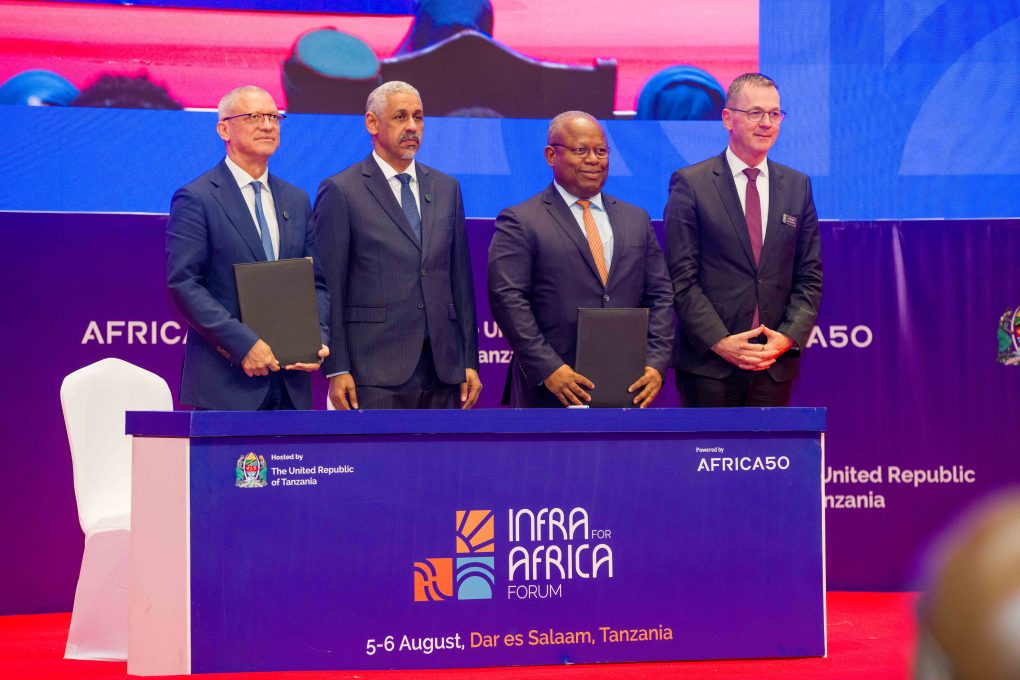
The agreement was announced at the Infra for Africa Forum, held August 5–6 in Dar es Salaam, Tanzania.
It creates a framework for BII and Africa50 to identify projects they can finance together, make joint investments, attract additional investors, and strengthen the pipeline of infrastructure projects ready for funding.
BII’s commitment has helped the fund reach a fourth close of approximately $330 million. The investor group includes the African Development Bank, the International Finance Corporation, and more than 20 African institutional investors.
The latest close puts the fund at about two-thirds of its $500 million target.
The fund is managed by Africa Infrastructure Investment Partners, an Africa50 subsidiary.
It is structured as a 12-year, closed-end private equity fund and invests in power and energy, water and sanitation, transport and logistics, and digital and social infrastructure.
Its focus includes both infrastructure projects and operating platforms, giving it scope to provide long-term equity across several markets and sectors.
Leslie Maasdorp, chief executive officer of BII, said the shortage of infrastructure finance continues to hold back growth across the continent.
“Africa’s infrastructure financing gap remains one of the biggest barriers to sustainable growth and development across the continent,” Maasdorp said.
He added that combining the two institutions’ capital, networks, and investment experience could bring more funding into critical sectors and improve the pipeline of viable projects.
The size of the challenge explains why the partnership extends beyond BII’s initial $20 million investment, with Africa50 placing Africa’s annual infrastructure financing shortfall at between $68 billion and $108 billion.
Alain Ebobissé, chief executive officer of Africa50, said the continent needs a larger pool of long-term private capital to deliver infrastructure more quickly.
“Africa’s infrastructure needs cannot be met by public capital alone,” Ebobissé said.
He described BII’s fund commitment as part of a broader effort to increase infrastructure investment, improve project execution, and attract long-term institutional money.
The participation of more than 20 African institutional investors is an important part of the fund’s model. Pension funds, insurers, sovereign wealth funds, and other long-term investors hold capital that can match the long operating life of infrastructure assets, but their allocations to African infrastructure remain limited in many markets.
Africa50 was established in 2015 by African governments and the African Development Bank to develop projects, invest capital, and bring other financiers into commercially viable infrastructure.
By October 2025, the platform reported investments in 32 projects across 30 countries, with a portfolio valued at more than $8 billion.
The commercial case for faster infrastructure investment is direct. Unreliable electricity raises operating costs, weak transport links slow trade, limited water systems constrain industrial and urban growth, and gaps in digital connectivity reduce access to fast-growing service markets.
The World Bank has identified electricity shortages and outages as a leading obstacle for African businesses, while better energy, transport, and digital systems can raise productivity and support larger, job-creating companies.