The July total was lower than the $334 million recorded in June, but the composition of the funding was more significant than the monthly decline.
Debt for battery manufacturing, electric mobility, clean energy, and other physical assets accounted for most of the capital.
TechCabal tracked 37 transactions during the month. Funding values were disclosed for 28 deals, while nine remained undisclosed.
Debt contributed $168.55 million, or 75.2% of the disclosed capital. Equity accounted for $55.51 million, or 24.8%, while grants supplied just $95,000.
The figures point to a funding market increasingly shaped by large industrial and asset-backed transactions.
However, they do not represent conventional venture capital alone. One battery manufacturing loan accounted for more than half of July’s total.
Morocco’s Battery Factory Leads July Funding
The largest transaction was a $114 million loan approved by the African Development Bank for Gotion Power Morocco, a subsidiary of Chinese battery producer Gotion High-Tech.
The financing will support the construction of an integrated lithium iron phosphate battery plant in the Rabat-Salé-Kénitra Free Trade Zone.
The African Development Bank describes the project as the first facility of its kind in Africa and the wider Middle East and North Africa region.
The first phase will have an annual production capacity of 10 gigawatt-hours of battery cells and packs for electric vehicles.
Long-term plans could expand the plant to 100 gigawatt-hours. The initial phase is expected to create more than 600 direct jobs and reach a local industrial integration rate of 70%.
“Battery storage is the missing link in Africa’s clean energy transition,” said Kevin Kariuki, the bank’s vice president for power, energy, climate, and green growth.
The project strengthens Morocco’s position in the global automotive supply chain.
The country already hosts vehicle assembly and component operations for manufacturers including Renault and Stellantis.
Adding battery production could allow Morocco to capture more value from electric vehicle manufacturing while building demand for African minerals, renewable power, logistics, and industrial services.
M-KOPA, Bridgement, and BioLite Secure Major Debt Facilities
Kenya’s M-KOPA Mobility secured a $30 million senior debt package from Dutch development bank FMO. The financing is directed at electric motorcycles and batteries in Kenya, not the company’s smartphone financing operations.
According to FMO’s project disclosure, up to $23 million will finance M-KOPA’s growing portfolio of electric motorcycle receivables. The remaining $7 million will refinance a shareholder bridge facility used during the business’s early operating period.
The facility addresses one of the main barriers to commercial electric mobility in Africa: affordable local financing. Motorcycle riders may benefit from lower fuel and maintenance costs, but most cannot pay for an electric vehicle upfront.
Credit providers that can match repayments to riders’ daily earnings will therefore be central to adoption.
South African online business lender Bridgement raised $20.3 million from Rand Merchant Bank and Standard Bank.
The funding will expand its capacity to provide loans to small and medium-sized businesses using bank, accounting, and operating data to assess borrowers.
The participation of two major South African banks is important, as it shows that established financial institutions are willing to fund technology-based lenders that can reach businesses often excluded by collateral requirements and slow credit assessments.
It also gives Bridgement more lending capital without requiring the company to sell a large ownership stake.
BioLite secured a $10.7 million senior debt facility from the Africa Go Green Fund to purchase and distribute at least 163,500 improved cookstoves in Zambia.
The facility will be repaid from future carbon-credit revenue generated by the project. The credits will be purchased by Switzerland’s KliK Foundation under the carbon-trading agreement between Zambia and Switzerland.
The structure combines a long-term carbon-credit purchase agreement, debt financing, and insurance against carbon-delivery risks.
If successfully implemented, it could provide a model for financing other African carbon projects that have traditionally depended on grants or advance credit sales.
Equity Still Reached AI and Workforce Platforms
Smaller equity rounds continued to support technology companies with lower physical infrastructure costs.
South African customer engagement company Cue raised $5 million in a round co-led by Knife Capital and FAM Investments.
Cue provides AI-based customer service across WhatsApp, webchat, email, SMS, Messenger, and voice channels.
The company says its platform is used by more than 500 businesses and manages over 500 million customer conversations each year.
Cue also reports that its AI agents independently resolve more than 60% of customer interactions and that annual recurring revenue has increased by 160% over the past year.
Kenyan recruitment and career platform Fuzu raised $3.86 million in Series A funding. Sparkmind.vc led the round, with participation from Finnfund, Seedstars International, and other investors.
The company plans to improve its recruitment technology and enter additional African markets. Fuzu’s platform has served more than 7.5 million users across East Africa, according to AfricanCIO.
These transactions show that equity investors remain active in African software businesses.
However, the size of the rounds was far below the debt provided to companies financing factories, vehicle portfolios, and energy assets.
Africa’s EV Market Is Becoming an Infrastructure Business
The funding for Gotion Power Morocco and M-KOPA shows that Africa’s electric mobility market is moving beyond vehicle imports.
Local battery production, vehicle financing, charging systems, battery-swapping stations, and reliable electricity are becoming part of the same investment opportunity.
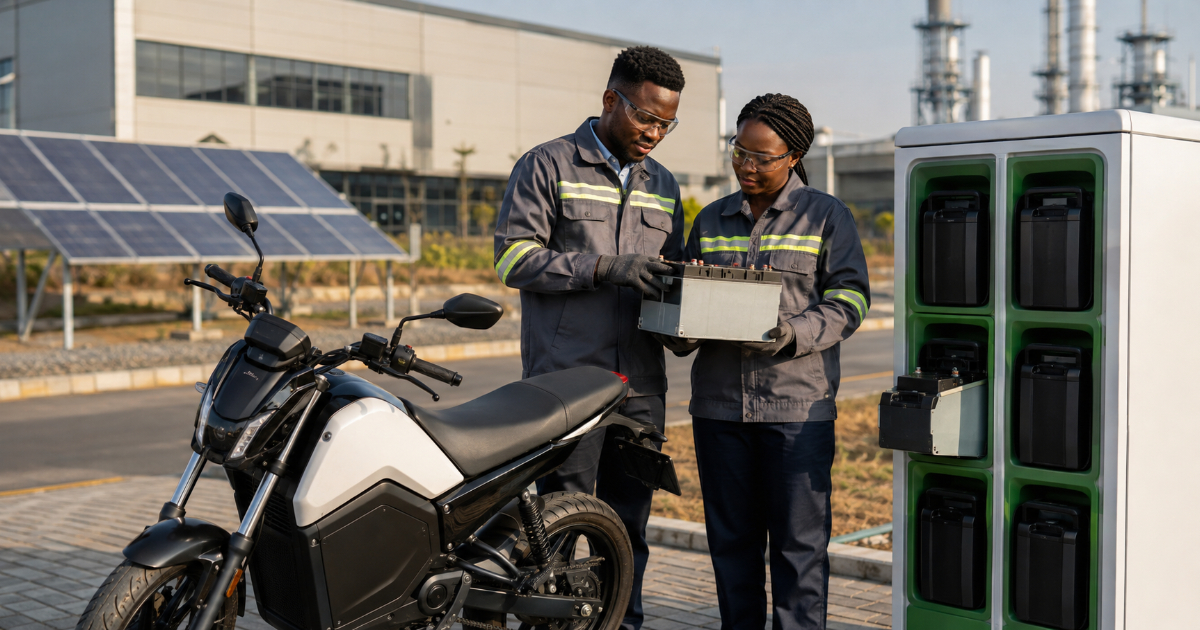
Nigeria’s Swap illustrates this shift. The company converts petrol-powered commercial tricycles into electric vehicles and charges drivers a daily fee for access to swappable batteries.
According to Catalyst Fund, a battery exchange takes less than five minutes, while Swap reports that converted tricycles can reduce operating costs by between 30% and 45%.
The commercial case is clear, but scaling depends on the availability and cost of charging infrastructure.
Weak grids can raise operating costs and limit the number of batteries that can be charged reliably. Companies that combine vehicles with energy generation, battery management, financing, and charging networks will be better positioned to expand.
The $10 million IFC investment in CrossBoundary Access supports the same infrastructure trend.
The company is building mini-grids, battery services, and distributed renewable energy projects in sub-Saharan Africa.
It currently supplies electricity to more than 170,000 people in Nigeria and Madagascar and is working toward reaching one million people. However, CrossBoundary announced that investment on June 24, so it should not be treated as a July announcement under a strict calendar-based count.
Why Funding Trackers Report Different Totals
The $1.66 billion year-to-date figure is based on TechCabal’s coverage and transaction classifications. Other trackers report lower totals.
Africa: The Big Deal, which tracks transactions of at least $100,000 under a different methodology, estimated that startups raised about $102 million in July and $1.46 billion during the first seven months of 2026.
Its July figure excluded the Gotion industrial loan and used different announcement dates for several transactions.
The timing of individual deals also affects monthly totals. Peach Cars’ approximately $4 million debt financing from Japan Finance Corporation and Shoko Chukin Bank was reported in August, while CrossBoundary Access announced its IFC investment in June.
The differences are not unusual. Caban Corporate Advisors found that estimates for African startup funding in the first half of 2026 ranged from $1.21 billion to $1.5 billion across four trackers.
Much of the variation came from how debt, industrial financing, and large asset-backed transactions were counted.
Debt Growth Does Not Mean Equity Has Recovered
July’s 75.2% debt share should not be read as evidence that African founders broadly prefer loans to equity.
The ratio was heavily influenced by the $114 million Gotion transaction and M-KOPA’s $30 million facility. Together, the two deals accounted for about 64% of all capital reported during the month.
Debt is increasingly important because more African technology companies are financing revenue-generating assets.
Factories, motorcycles, batteries, solar systems, cookstoves, and loan portfolios can support structured repayments in a way that early-stage software businesses often cannot.
The wider funding market remains concentrated. Research published by Nanyang Technological University’s Centre for African Studies found that only 190 African ventures raised at least $100,000 during the first half of 2026, the lowest half-year total since tracking began in 2021. The number raising between $100,000 and $1 million fell 44% from the previous six months.
July therefore offers two different signals. Large African businesses and industrial projects can still attract substantial debt from development banks and commercial lenders. At the same time, smaller companies continue to face a tighter equity market.