Every year, African governments, state-owned enterprises and donor-financed projects sign contracts worth an estimated $500 billion or more — around 15 to 20 percent of the continent’s combined GDP of roughly $3.0 to $3.1 trillion.
That is a bigger number than Africa’s total foreign direct investment inflows, and comparable to the entire economic output of East Africa.
No single institution publishes an official, continent-wide total. The figure used here is a synthesis: procurement-to-GDP ratios documented in World Bank country assessments and OECD public-governance data, applied to Africa’s aggregate GDP.
The African Development Bank and the Open Contracting Partnership use estimates of similar magnitude to describe the size of the market. Treat it as an order of magnitude rather than an audited figure.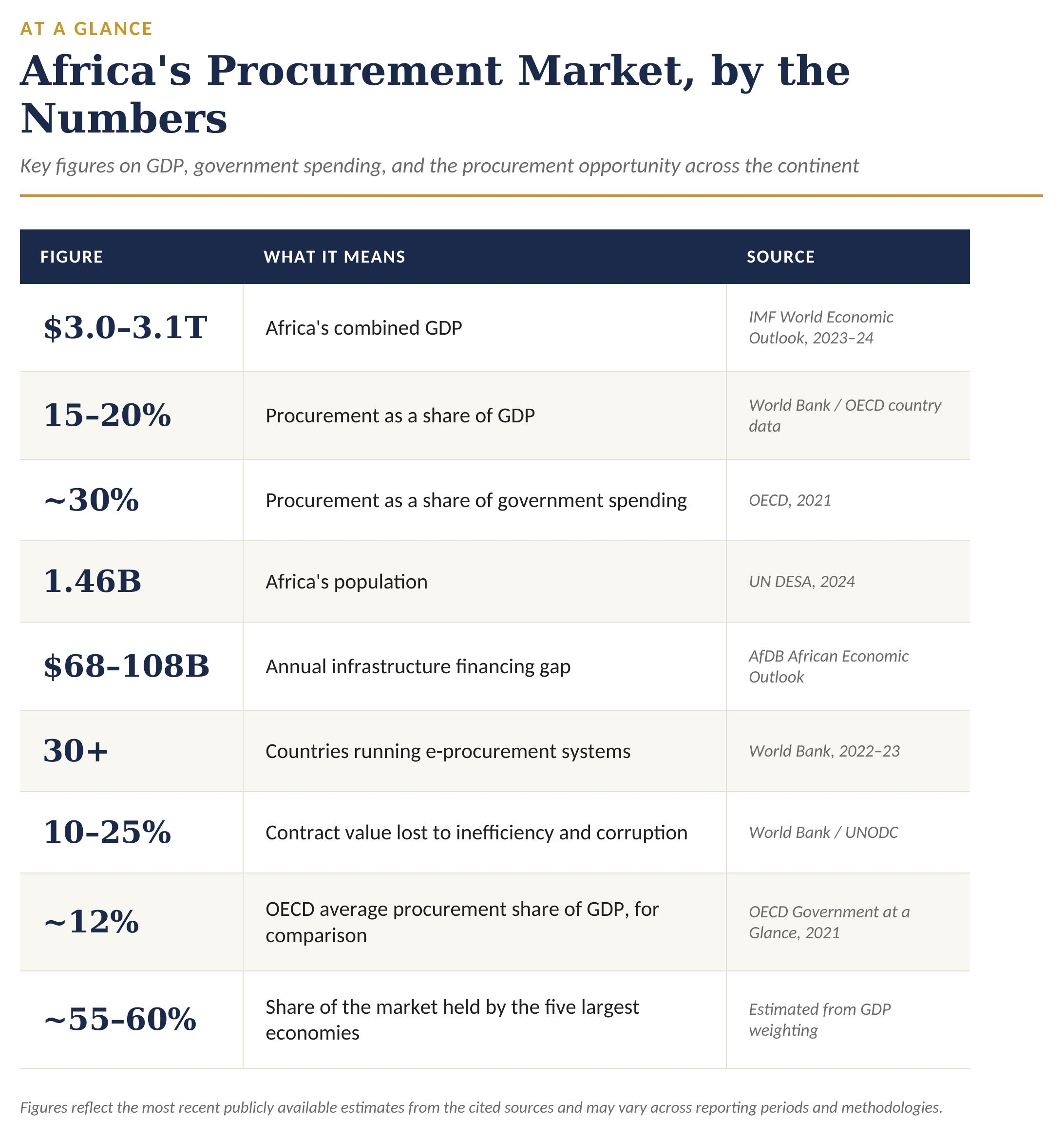
Market overview
Procurement spend runs through four channels: national ministries, sub-national and municipal governments, state-owned enterprises, and donor-financed projects.
The largest categories of spend are infrastructure — roads, rail, ports and power — followed by health and pharmaceuticals, defense and security, education, and information and communications technology.
State-owned enterprises carry an outsized share of activity in the continent’s biggest economies, particularly in energy and extractives: national oil companies in Nigeria, Algeria and Angola, and power utilities such as Eskom in South Africa and Kenya Power, procure at a scale that often exceeds the budget of the ministries that oversee them.
Because SOE spend is typically reported separately from central government budgets, it is one of the main reasons a single, clean continental total does not exist.
System maturity also varies enormously. Rwanda, Kenya, South Africa and Ghana have dedicated procurement regulatory bodies and functioning e-procurement portals.
Many lower-income and fragile states still run tenders on paper, with limited public disclosure, a gap the World Bank and the Open Contracting Partnership identify as a primary source of inefficiency.
Large donor-financed programs from the World Bank, AfDB, EU and bilateral agencies frequently run on the financier’s own procurement rules rather than the host country’s, particularly for major infrastructure and health projects.
Regional comparison – Where the money is concentrated
Procurement activity tracks economic output closely.
West Africa and Southern Africa lead in absolute value on the strength of Nigeria and South Africa respectively; Central Africa remains both the smallest market and the least digitized.
Country rankings – Five countries, more than half the market
Nigeria, South Africa, Egypt, Algeria and Morocco are estimated to account for over half of continental procurement value — a direct reflection of their combined share of GDP.
Market size and market quality are not the same thing, though: several smaller economies run more transparent, more digitized procurement systems than their larger neighbors.
Trend Analysis – A market shifting from paper tenders to open data
Two decades of uneven growth
Africa’s GDP has not grown in a straight line, and neither has the procurement market layered on top of it.
The period since 2010 breaks into three distinct phases: a commodity-fueled expansion through 2014, a slowdown driven by the 2015–16 oil price collapse and currency devaluations in Nigeria and Angola, and a recovery from 2017 that was interrupted by the 2020 contraction — the continent’s first outright recession in more than twenty-five years, according to the World Bank — before rebounding through 2023.
Holding the procurement share of GDP roughly constant across this period, the market’s nominal value would have moved in step with these swings: expanding through the early 2010s, flattening for two to three years in the middle of the decade, and resuming growth thereafter.
The $500 billion estimate at the center of this briefing reflects the 2023–24 endpoint of that trajectory, not a stable long-run average.
The digitalization wave, 2015–2024
Reform over the past decade has run on two tracks: moving tenders from paper to electronic systems, and, more recently, making the resulting data public.
Rwanda’s Umucyo platform, launched in the mid-2010s, remains the continent’s most complete example of end-to-end electronic tendering under a single oversight authority.
Kenya integrated e-procurement into its national IFMIS financial-management platform over the same period, and Ghana’s GHANEPS went live toward the end of the decade.
Nigeria’s Bureau of Public Procurement has taken a parallel path, publishing tender and award data through an open contracting portal rather than digitizing the tendering process itself first, a sequencing choice that has made Nigerian procurement data unusually visible for a market of its size, even where the underlying process remains only partly electronic.
South Africa took the most significant legislative step in the region in 2024, when a new Public Procurement Act was signed into law to consolidate a fragmented body of procurement-related instruments — accumulated over more than two decades — into a single framework with one central regulator.
Implementation is still underway, and its practical effect on tender timelines and transparency will not be clear for several years.
The 2020–21 shock and its aftermath
The pandemic produced the sharpest short-term disruption to procurement practice in a decade.
Emergency rules that suspended competitive tendering for medical supplies, personal protective equipment and vaccines pushed a meaningful share of annual health spending through single-source or expedited contracts within a matter of months.
South Africa’s Special Investigating Unit subsequently opened a review covering several billion dollars in pandemic-related contracts, and equivalent audit processes followed in other countries — a pattern that has left emergency procurement rules under closer legislative scrutiny than before 2020.
The other lasting effect has been financial rather than procedural: public-private partnerships have taken a larger share of new transport and energy projects as governments emerged from the pandemic with less fiscal headroom.
PPP-financed infrastructure investment in Sub-Saharan Africa remains a small fraction of total public capital spending, but it has grown from a low base and is the fastest-expanding delivery model tracked in the World Bank’s Private Participation in Infrastructure database.
The next chapter: rules, data and scale
Three developments will shape the next five years more than any others. First, scale: the IMF’s projected regional GDP growth of roughly 4 percent a year would, if the procurement-to-GDP ratio holds, carry the market from its current $500 billion base to approximately $560 billion by 2027 through compounding alone — before any effect from reform or digitization.
Second, rules: negotiations on an AfCFTA protocol covering government procurement are underway but have not concluded, and the timeline for any cross-border market access remains unset.
Third, data: as more countries adopt open contracting standards, the quality of continent-wide procurement statistics should improve enough that future editions of this briefing can rely on reported figures rather than estimates derived from GDP ratios.
Drivers behind the numbers – What is shaping demand
Structural and economic
The UN projects Africa’s population will reach 2.5 billion by 2050, which sets a floor under demand for housing, water, transport and health infrastructure for decades to come.
In resource-rich states, Algeria, Nigeria, the DRC, hydrocarbon and mineral revenue directly funds public investment, which means procurement volumes rise and fall with commodity prices.
Technological
Electronic procurement systems are cutting processing time and cost by double digits where fully implemented, according to World Bank studies, and cloud-based platforms are making it cheaper to extend e-procurement down to municipal and rural government units.
Regulatory and institutional
AfCFTA includes provisions for eventually liberalizing government procurement across borders, though implementation remains at an early, largely aspirational stage.
Separately, open-contracting and anti-corruption initiatives are pushing a growing number of governments toward mandatory disclosure of tender and award data.
Environmental and geopolitical
Climate commitments are steering a growing share of procurement toward renewable energy and climate-resilient infrastructure, backed by instruments like the Green Climate Fund and AfDB’s Africa Climate Change Fund.
Meanwhile, China, the Gulf states and the EU’s Global Gateway initiative are all competing for a larger share of the continent’s largest infrastructure contracts, changing who ends up winning them.
Investment landscape – Who is financing, building and bidding
The World Bank Group, IFC and AfDB remain the largest institutional financiers of procurement-linked infrastructure, with AfDB’s Programme for Infrastructure Development in Africa (PIDA) the main continental vehicle.
The EU’s Global Gateway initiative and bilateral agencies, France’s AFD, Germany’s GIZ and KfW, Japan’s JICA, USAID, finance projects that typically run through national or hybrid procurement systems.
China’s Export-Import Bank and China Development Bank finance a large share of the continent’s biggest infrastructure contracts, usually delivered by Chinese state-linked contractors outside competitive national tendering.
On the contracting side, international firms including Vinci, Bouygues, China Road and Bridge Corporation, China State Construction Engineering Corporation and China Communications Construction Company win a disproportionate share of large tenders, alongside regional players such as Nigeria’s Julius Berger.
Recent large-scale examples include the Chinese-financed Lagos–Ibadan railway, Kenya’s Nairobi Expressway, built under a build-operate-transfer structure, and Nigeria’s Lekki Deep Sea Port, a public-private partnership involving both Nigerian and Chinese stakeholders.
Closing Africa’s $68–108 billion annual infrastructure gap will require a mix of public procurement budgets, blended finance and PPP structures, public money alone is not enough to fund it.
The clearer opportunities sit in three areas: govtech platforms for e-tendering, e-payment and supplier verification, aimed at the majority of governments still running manual systems; PPP-structured infrastructure in transport, energy and water, where budgets alone cannot close the financing gap; and SME-focused financing tied to the preferential-procurement set-asides — typically 20 to 30 percent of contract value — that South Africa, Kenya and Nigeria already mandate by law.