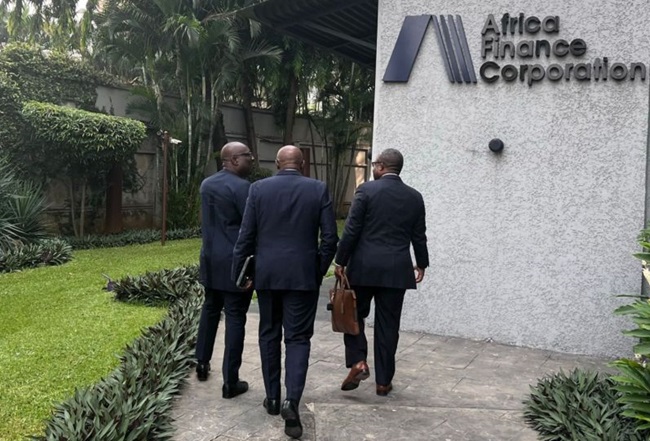
The Lagos-based multilateral finance institution announced the transaction on August 12, 2026, describing it as the first digital bond from an African institution to be listed, traded, and settled through regulated digital market infrastructure.
The dollar value is based on the Federal Reserve’s August 12 exchange rate of 0.8117 Swiss francs per dollar.
The bond carries a 1.4925% coupon and was issued under AFC’s $5 billion Global Medium-Term Note Program.
It is structured as a tokenized security using distributed ledger technology, with ownership recorded on a regulated digital register.
The security is listed and admitted to trading on the SIX Swiss Exchange and deposited with SIX Digital Exchange, while clearing and settlement are handled through infrastructure operated by SIX SIS AG.
AFC said the transaction is also the largest digital bond issued in the Swiss-franc market.
Commerzbank AG served as technical lead for the transaction, while Deutsche Bank AG London Branch, acting through Deutsche Bank AG’s Zurich branch, also arranged the issuance.
Approximately 90% of investor demand came from Swiss accounts, while international investors accounted for the remaining 10%. Banks and other financial institutions represented 57% of the order book, followed by asset managers at 37% and hedge funds at 6%.
The concentration of Swiss institutional demand gives AFC access to a funding pool beyond its established dollar investor base.
The transaction is the corporation’s fourth and largest Swiss-franc issuance, following its first green bond in that market in 2020.
It also came shortly after AFC raised $500 million through a five-year senior unsecured Eurobond in July 2026, which carried a 5.375% coupon and attracted orders worth about twice the amount offered.
AFC entered the digital bond market with investment-grade ratings from two major agencies.
S&P Global Ratings assigns the institution an A rating with a positive outlook, while Moody’s Ratings reaffirmed AFC’s A3 rating and stable outlook on August 14. These ratings support the corporation’s ability to raise long-term financing from investors that must operate within defined credit-quality requirements.
AFC President and CEO Samaila Zubairu said that “expanding the range of capital solutions available to AFC will remain central to mobilising long-term financing at scale.”
The corporation’s funding diversification is important because infrastructure projects typically require large amounts of capital with repayment periods that extend beyond those available through short-term bank lending.
Established in 2007, AFC finances and develops projects in energy, transport, telecommunications, natural resources, and heavy industry.
The institution has 48 member countries and has invested more than $19 billion in 36 African countries.
Its 2025 financial results showed total assets of $19.23 billion and net profit of $444.8 million, providing a broader balance-sheet base for project development, direct investment, lending, and financial advisory work.
A digital bond remains a regulated fixed-income obligation rather than a cryptocurrency investment. The main difference lies in how ownership and transaction records are maintained and how settlement is completed.
For African issuers, AFC’s transaction demonstrates that distributed ledger technology can be incorporated into an established regulatory, trading, and settlement framework while retaining the credit and legal protections expected by institutional investors.
The issuance also comes as digital debt moves from limited market trials toward wider institutional use. SIX completed another digital bond issuance in 2025, while the United Kingdom Treasury plans to issue its first Digital Gilt Instrument by the first quarter of 2027.
AFC’s participation places an African infrastructure financier within this shift in global capital-market infrastructure.
Because the proceeds are assigned to AFC’s general funding needs rather than a named project, the transaction should be viewed primarily as an expansion of the corporation’s financing capacity and investor access.
Its wider business significance will depend on how effectively AFC converts the additional capital into bankable energy, transport, industrial, and digital infrastructure that can improve trade, productivity, and private-sector growth across its member countries.