Breega led the round, The Catalyst Fund participated, and the Mulago Foundation provided non-dilutive funding.
BIG announced the financing on September 17, 2026, and said it will use the capital to establish more partnerships with food processors.
The company installs and operates biochar production systems at factories, converting agricultural residues such as nut shells, husks, stalks, and corn cobs into carbon removal products.
Its Biochar-as-a-Service model is designed to reduce the upfront investment required from food processors.
BIG finances, installs, and operates equipment at qualifying factories, adapting each system to the available agricultural waste and local operating conditions. Revenue generated from biochar and verified carbon removal credits is then shared with participating processors.
The systems use continuous pyrolysis, which heats agricultural biomass at temperatures above 600°C in an environment with little or no oxygen.
This process converts part of the biomass carbon into a stable solid material that can store carbon for extended periods instead of allowing it to return quickly to the atmosphere through decomposition or burning.
The resulting biochar can also be applied to farmland as a soil amendment. Its performance varies by soil type, feedstock, production conditions, and application method, but it can improve water retention, recycle nutrients, and support soil management when used appropriately.
BIG’s factory-based approach links carbon removal to an existing industrial waste stream, which could reduce the cost and complexity of collecting biomass from dispersed sources.
Locating production equipment at processing facilities also gives the company a consistent source of feedstock while helping agribusinesses convert waste-management costs into potential revenue.
“Africa has natural advantages to lead the most scalable and cost-effective biomass-based carbon removal globally,” said BIG co-founder and CEO Ikenna Nzewi.
“By forming true win-win partnerships with agricultural processors to produce biochar, we have the opportunity to turn localised waste liabilities into a transformative global solution.”
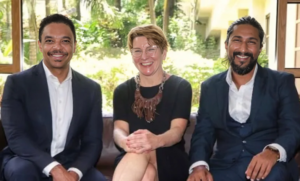
Nzewi founded BIG with Chief Technology Officer Uzoma Ayogu and Chief Operating Officer Isaiah Udotong.
The three founders previously built industrial agricultural infrastructure through Releaf Earth, a Y Combinator-backed agricultural processing company that developed patented nut-processing equipment and worked with thousands of smallholder farmers in Nigeria.
Breega Partner Tosin Faniro-Dada said the investment reflects BIG’s ability to apply that operational experience to carbon removal.
“BIG is turning a real industrial waste problem into repeatable, audit-grade carbon credits, and doing it with a level of operational discipline that’s rare this early,” she said.
The investment comes as soil degradation and limited access to suitable agricultural inputs continue to constrain food production across sub-Saharan Africa.
The Food and Agriculture Organization reported in 2026 that degradation affects about 65% of Africa’s agricultural land, while average nitrogen fertilizer use in the region was approximately 13 kilograms per hectare in 2022, compared with a global average of about 65 kilograms.
Demand for durable carbon removal is also attracting more private capital, although the sector remains at an early commercial stage.
The International Energy Agency reported in 2025 that the number of carbon removal startups had increased fivefold over five years, while venture capital investment in the sector had risen sevenfold.
The agency identified reliable monitoring, reporting, and verification as essential to establishing the permanence and credibility of carbon removals.