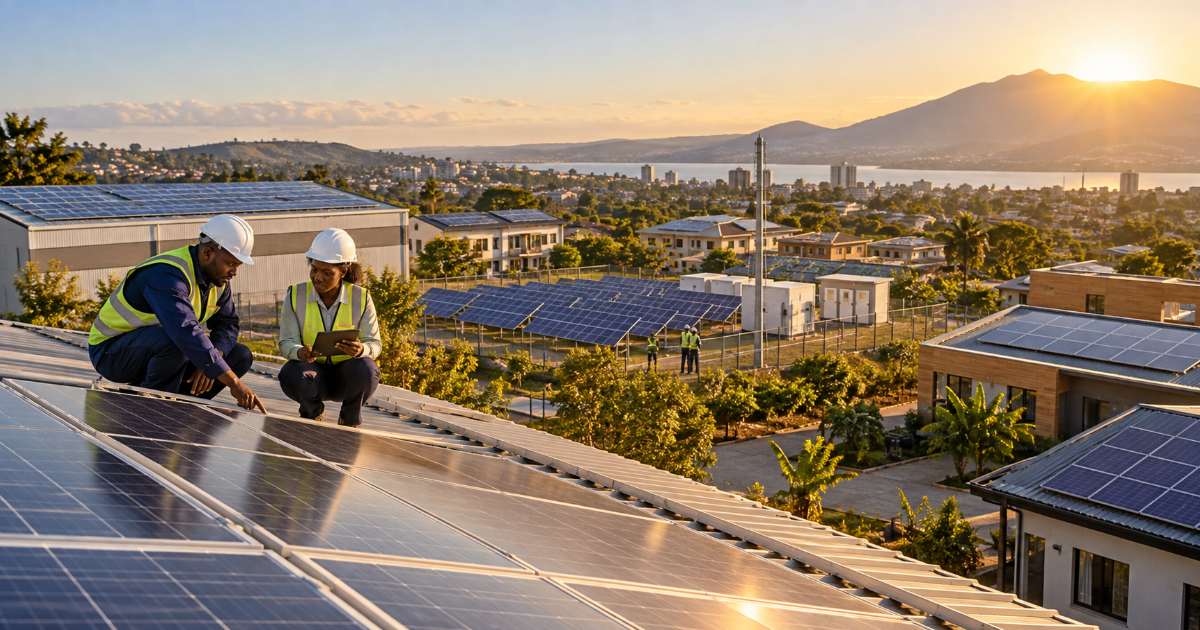
The projected installations are equivalent to about 100,000 solar panels per day.
Ember developed the estimate using Chinese customs data, historical installation patterns and adjustments for shipping times, equipment held in storage, re-exports and local manufacturing.
The analysis estimates that approximately 73% of reported Chinese solar panel exports are eventually installed, typically after a six-month delay.
Solar deployment is expanding beyond the continent’s established markets. Thirty-six of Africa’s 54 countries are expected to install record amounts of solar capacity in 2026, while 19 could record year-on-year growth of more than 100%.
The Democratic Republic of Congo is projected to register a 544% increase, followed by Zimbabwe at 282%, Egypt at 176% and Zambia at 117%.
South Africa remains a major solar market, but its share of Africa’s annual installations is expected to fall below 20% for the first time since 2019 as deployment accelerates elsewhere.
The shift indicates that solar adoption is becoming more geographically diverse as households and businesses respond to unreliable electricity supply, rising energy costs and the expense of operating diesel generators.
The 17 GW expected to enter service could generate approximately 23 terawatt-hours of electricity annually, equivalent to 2.3% of Africa’s current electricity generation.
That output is slightly higher than the continent’s average annual electricity demand growth of 2.2% between 2014 and 2024, suggesting that new solar capacity could supply a substantial share of near-term demand growth if the installations perform as estimated.
Much of the expansion is taking place outside large power projects. Ember estimates that distributed solar systems accounted for 20 GW, or 75%, of the 26 GW of solar capacity added across Africa between 2023 and 2025.
These customer-owned systems, which are commonly installed on homes and commercial buildings, are difficult to capture through conventional government reporting.
Only 12 African countries publish official or semi-official distributed solar figures, while national solar capacity data is available for 36 countries.
Just 14 countries had reported figures covering 2025 when the study was prepared.
This gap means that utilities, regulators and investors may be making decisions using incomplete information about existing generation and electricity demand.
Joel Nana, research director at the African Tech Futures Lab, said policymakers must respond to the rapid growth of distributed energy resources.
“Policymakers need to start responding to this shift,” Nana said, emphasizing the need to integrate privately installed systems into national power planning.
Accurate data will become increasingly important as distributed solar changes daytime electricity demand, battery requirements and investment needs across national grids.
Weak reporting could lead utilities to overestimate future demand, procure unnecessary generation or plan grid investments without accounting for electricity already being produced at customer sites.
The expansion also comes as Africa continues to face the world’s largest electricity-access deficit.
More than 560 million people in Sub-Saharan Africa lacked electricity in 2024, according to the World Bank and other agencies responsible for tracking Sustainable Development Goal 7.
Decentralized solar can help narrow this gap in areas where extending the national grid is expensive or slow.
A 2026 International Renewable Energy Agency report found that renewable mini-grids and direct solar applications could support electricity access and essential services across Benin, Burkina Faso, Côte d’Ivoire, Guinea, Mali, Niger, Senegal and Togo.
Rural electricity access averages about 30% across these countries but falls to approximately 10% in Niger and 2% in Burkina Faso.
IRENA found that mini-grids and dedicated solar systems are better suited than basic household systems to powering irrigation, water pumping, cold storage, vaccine refrigeration and communications infrastructure.
These applications can strengthen agricultural productivity, healthcare delivery and small-business operations, although their value depends on reliable service, storage and long-term maintenance.
Africa’s record solar expansion shows that businesses and households are already investing directly in alternatives to unreliable or costly power supplies.
Better national data, clearer regulations and closer integration of distributed systems into electricity planning will determine whether this privately driven growth can support stronger grids, wider energy access and sustained business activity across the continent.